
News
AquaPLAN has crossed its equator!

Kicking off the year with momentum, collaboration and fresh ideas, in the words of Yana Yakushina, AquaPLAN has officially crossed its ‘equator’, marking the beginning of the project’s second half. The Annual General Meeting (AGM) held in Lisbon from 13–15 January 2026, offered the perfect opportunity to take stock of the solid foundations built across all work packages (WPs), celebrate major achievements and collectively launch the next phase with renewed energy after three productive days of meetings, workshops and collaboration.
Thank you to our strong and supportive community
AquaPLAN extends its warmest thanks to everyone contributing to the project’s success, including:
- All stakeholders involved
- Members of our Stakeholder Innovation Board (SIB) and Strategic/Scientific Advisory Board (SAB) for their important insights
- Our EC Project Officer Mrs. Colombe Warin, for her continued support
- Yana Yakushina, representing our sister project PLAN-B, for her valuable contributions
Your insights and collaboration plays an essential role in AquaPLAN’s progress.
WP2 completed – Review of the state of the art
With the submission of Deliverable 2.5 – Report on policy instruments for managing the impacts of light and noise (LNP) on aquatic biodiversity and ecosystem services (including recommended best practice), led by Plymouth Marine Laboratory (PML), WP2 is now formally concluded! This comprehensive review outlines the current policy landscape related to LNP, summarising regulatory frameworks, best practices and recommendations. This first policy-oriented report is also highly relevant for the ongoing EU public consultation on revising marine environmental protection rules.
WP3 milestone achieved: Dual-stressor mapping released
We have reached a major milestone with the delivery of the first integrated mapping of LNP across key marine areas (Deliverable 3.6 led by PML) – a major step forward for WP3: Monitoring exposure of biodiversity to LNP combined risks. This accomplishment marks the completion of Task 3.1: Exposure Mapping and Modelling. A highlight of this work is the release of the AquaPLAN Visualisation Portal, developed by Tim Smyth and Benjamin O’Driscoll (PML). The portal will be a key tool for future environmental assessments focusing on combined LNP risks.
WP5 Fully operational — Towards Good Environmental Status (GES)
Led by Thomas Davies (University of Plymouth (UOP)), Deliverable 5.1 – Report on the methodology for defining the criteria for GES, including tabulated Level of Onset of Biological Adverse Effect (LOBE) values for pelagic and benthic invertebrates and threshold GES values, represents a significant step toward integrating light pollution indicators into GES assessments across EU marine waters.
As part of Task 5.2, an engaging hybrid workshop ‘Potential Novel Mitigation Solutions’ was organised by Rosalyn Seddon (Centre for Environment, Fisheries and Aquaculture Science (CEFAS)) and brought together AquaPLAN partners, SIB and SAB members, and external stakeholders. Workshop participants explored and discussed mitigation solutions for LNP in aquatic habitats, providing structured input for the upcoming survey on innovative mitigation options, officially launching the solution oriented phase of WP5.
WP1 – Project management and beyond
Deliverable 1.5, Data Management Plan (DMP) – second release led by University of Pisa (UNIPI) is currently being implemented. The consortium is now strengthening data governance procedures in view of the future publication.
Deliverable 1.2, Report on monitoring of the ethical considerations during the implementation of the work plan, is now under revision to be updated. An expanded section on ethics and AI, which will be further developed in the coming weeks thanks to the collaboration of Alessio Tacca from Istituto Universitario di Studi Superiori (IUSS) Pavia. Dr Tacca gave a thought‑provoking talk on AI ethics in EU projects at our AGM, sparking lots of discussions among partners afterwards.
Impact of environmental disturbance on aquatic ecosystems
The final morning of the AGM was dedicated to an open science event ‘Impact of environmental disturbance on aquatic ecosystems’ with fascinating from AquaPLAN partners as well as local researchers. The talks collectively addressed how human disturbances, including LNP impact aquatic biodiversity across freshwater, coastal and marine ecosystems, combining scientific assessment and dual-stressor risk mapping with policy and management perspectives, particularly in the Portuguese context (images below).
Looking ahead: A strong second half for AquaPLAN
As AquaPLAN enters its second half, we are entering our core phase of experimental and manipulative activities, efforts will be focused on:
- Methodological integration across WPs
- Innovation in mitigation strategies
- Policy development towards future GES indicators
- Strengthened stakeholder and community engagement
More results, tools and activities will follow soon – stay tuned and subscribe to our news!
For more information, check out our meeting agenda and some images from the AGM (click on each image to enlarge it):
-
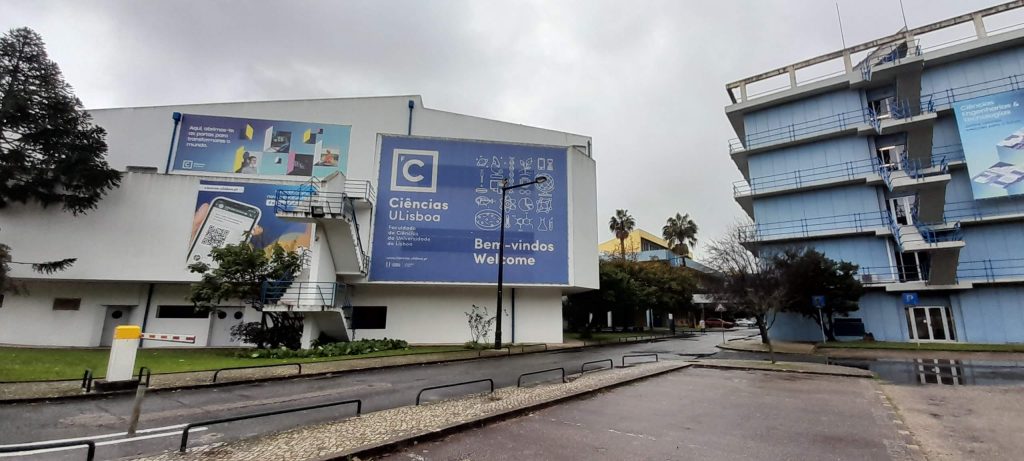
- Fig. 1: The façade of the Faculty of Sciences of the University of Lisbon campus—marked by its square C–F logo, part exponent and part atomic orbit—capturing the spirit of the sciences taught within, from carbon structures to the building blocks of life. A fitting backdrop, and the perfect setting, for this year’s AquaPLAN Annual General Meeting.
-
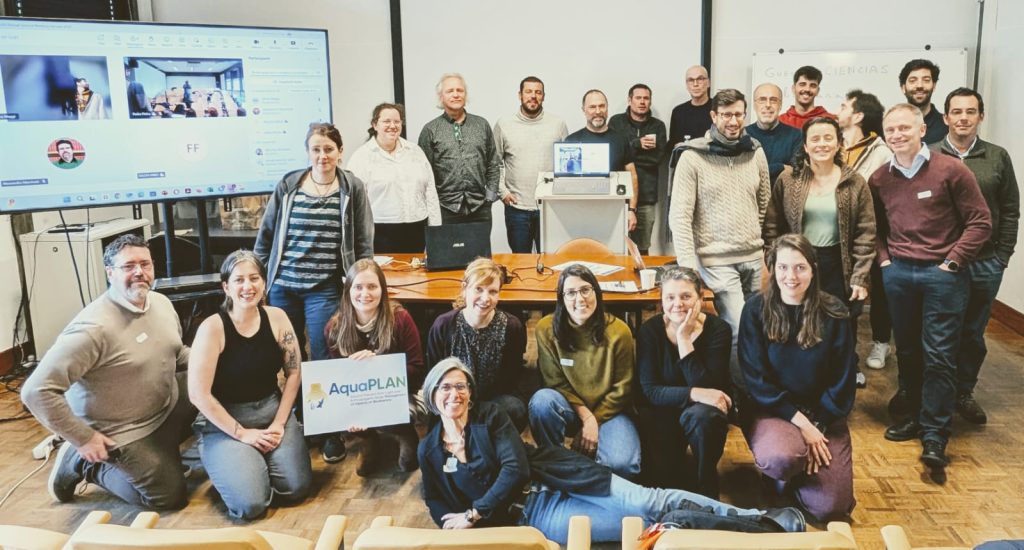
- Fig. 2: Group photo taken during the second day of the meeting (14/01/2026). From left to right and from front to back: A. Marchetti (UNIPI), A. Dickerson, V. Dekan Carreira (FC.ID), L. Doksaeter Sivle (IMR), E., Maggi (UNIPI), M. Mulas (UNIPI), F. Rossi (SZN), R. Seddon (DEFRA|CEFAS), C. Underwood (UOP), B.Martins Carreira (CIENCIASULISBOA), O. Rendón (PML), T. Smyth (PML), L. Dörner (ULEI), H. Slabbekoorn (ULEI), A. Rodríguez (CSIC), M. Aubé (Cégep de Sherbrooke), T. Davies (UOP), F. Holker (FVB-IGB), R. Rebelo (CIENCIASULISBOA), V. Maximino (FC.ID), B. Rocha (CIENCIASULISBOA), M. Vieira (CIENCIASULISBOA), P. Pinho (FC.ID).
-
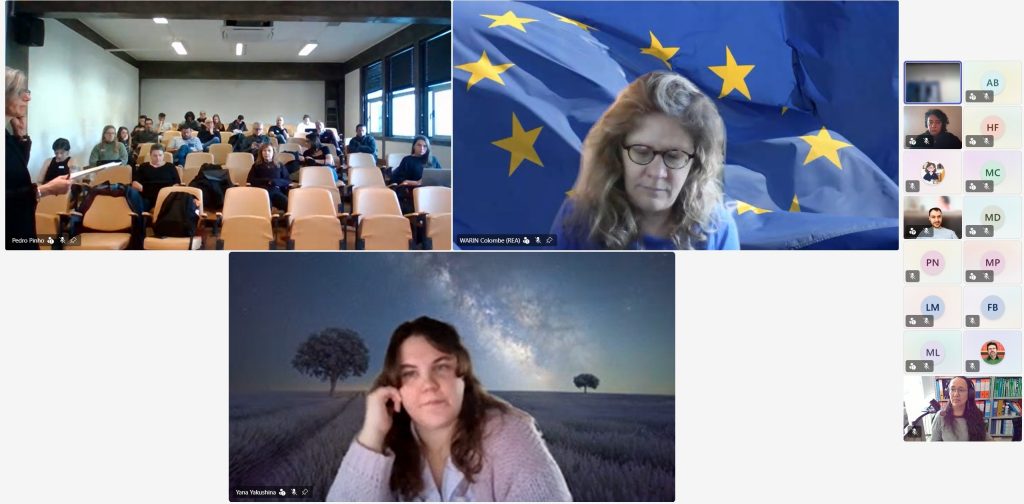
- Fig. 3: A moment from the second day of the meeting (14/01/2026), featuring greetings from European Commission Project Officer C. Warin, followed by the presentation ‘Plan B | The Path Towards Addressing Adverse Impacts of Light and Noise Pollution on Terrestrial Biodiversity and Ecosystems: Insights from our sister project’ delivered by Y. Yakushina from Ghent University.
-
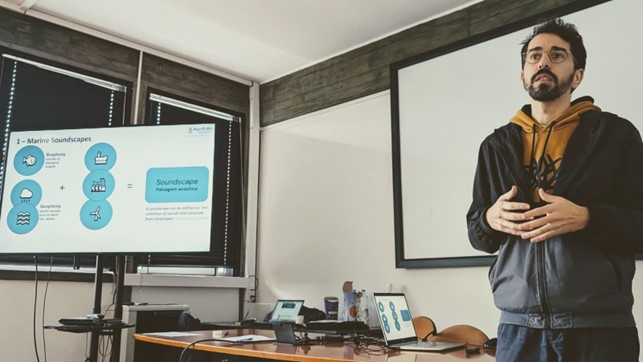
- Fig. 4: M. Vieira, researcher from the Faculty of Sciences of the University of Lisbon (CIENCIASULISBOA), with his presentation on marine soundscapes and bioacoustics.
-
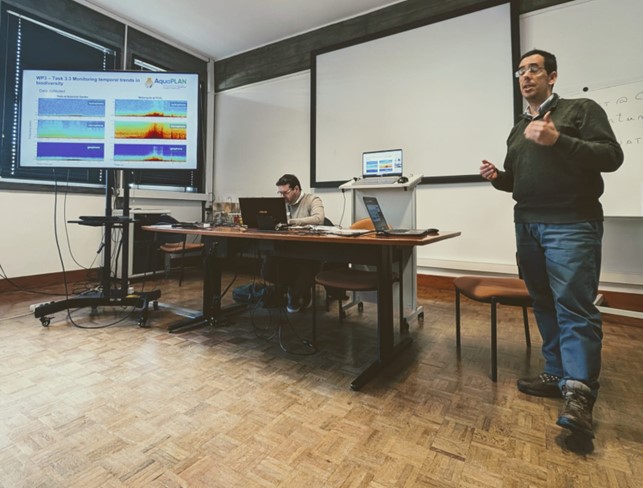
- Fig. 5: P. Pinho, researcher on urban ecology topics (FCiências.ID – Association for Research and Development in Sciences (FC.ID)), presented his research on monitoring temporal trends in light and noise pollution, emphasising the importance of accounting for the spatial characteristics of ecological data to better understand the relationships between biological and environmental variables.
-
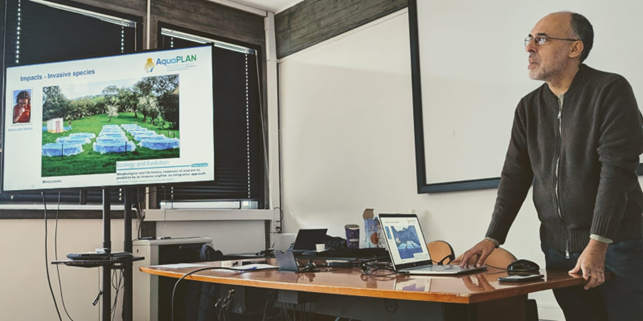
- Fig. 6: R. Rebelo, Professor of Herpetology and Ecology at the Faculty of Sciences of the University of Lisbon (CIENCIASULISBOA), presented key insights on invasive species and their ecological impacts.
-
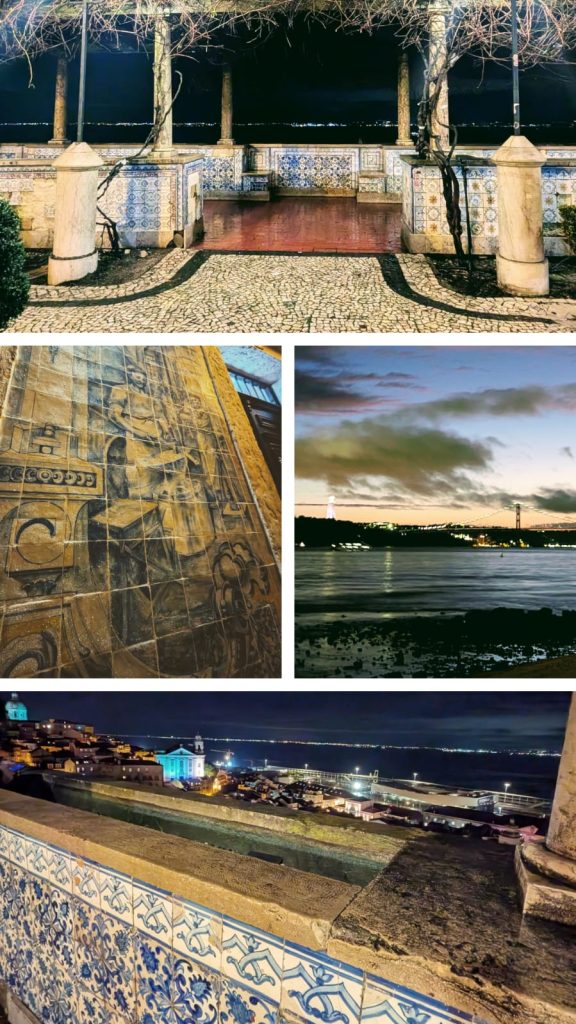
- Fig. 7: Light pollution over Lisbon and a balcony lined with traditional azulejos seen from the viewpoint near São Jorge Castle, in front of the cathedral.
-
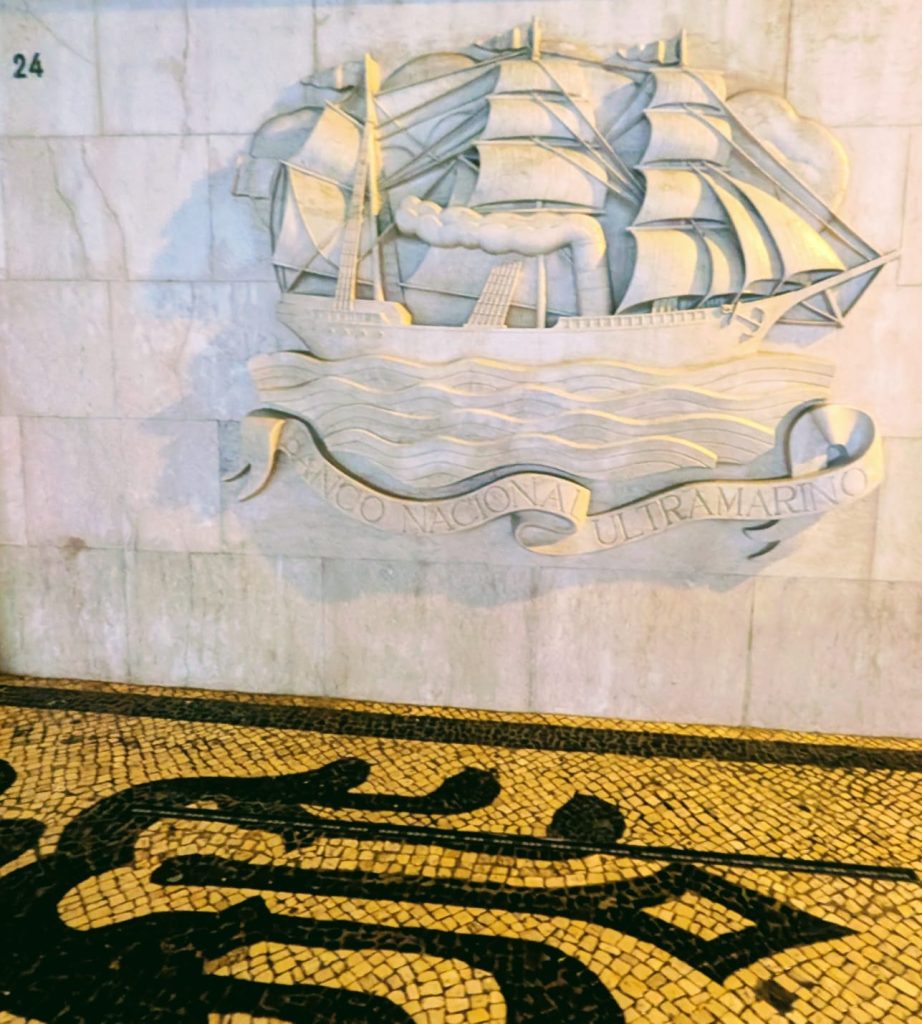
- Fig. 8: A picture of the former headquarters of the Banco Nacional Ultramarino — once a cornerstone of Portugal’s colonial-era banking system — now hosts the striking MUDE: Museum of Design and Fashion. The building’s historic industrial architecture frames the exhibitions beautifully. The bank emblem, still visible on the façade, symbolises Portugal’s maritime expansion and the global reach of its overseas territories.
Keep up to date with all the latest from AquaPLAN